- info@eeasyworldvision.com
- +91 88662 44440
- +91 72010 10440
- Mon to Sat: 10.00AM to 6.30PM
Canada Study Permit 2026: PAL/TAL & Funds for Indians
18
November
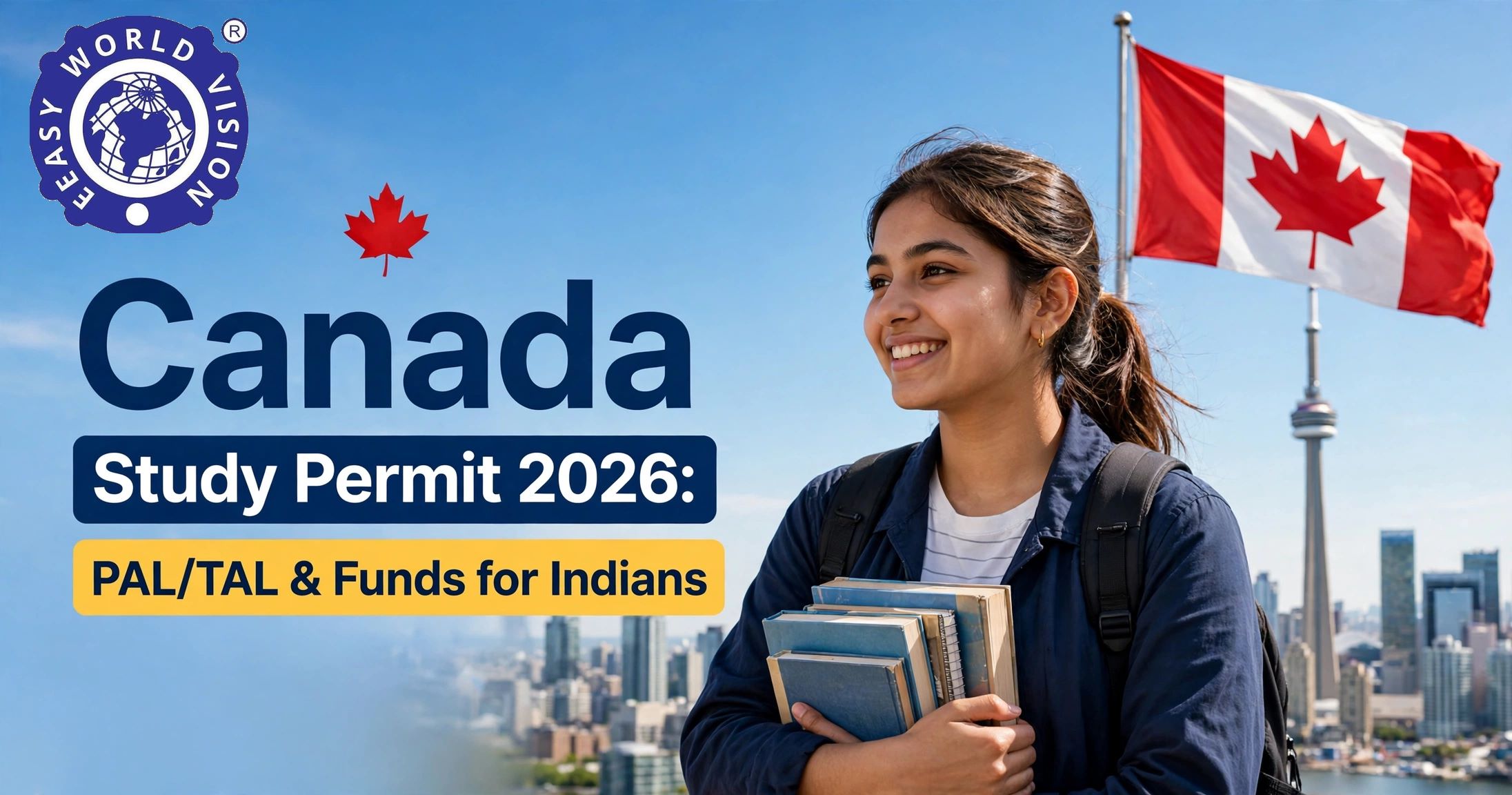
Canada Study Permit 2026: PAL/TAL & Funds for Indians
Every year, a lot of Indian students lose weeks over one missing letter or one badly explained bank deposit. Not because they weren’t good enough, but because nobody told them what the file needed to look like. The Canada Study Permit 2026 process rewards students who plan early, so let’s go through it properly.
Who Actually Needs a Study Permit?
If your course runs longer than six months, you’ll generally need a study permit. It lets you study at a Designated Learning Institution (DLI), which is simply a school the Canadian government has approved to host international students. No DLI, no permit. Check that before you pay any deposit.
Canada Study Permit Requirements: The Checklist
The Canada Study Permit Requirements look long on paper, but they’re manageable once you split them up:
-
A Letter of Acceptance (LOA) from a DLI
-
A passport valid for your whole stay
-
Proof of funds covering tuition, living costs and travel
-
A PAL or TAL, if your program needs one
-
Certificates, mark sheets and transcripts
-
A study plan
-
Biometrics, and medical or police clearance where asked
Most students find the study plan the hardest part. It’s your chance to explain, in plain words, why this course and why Canada. Skip the dramatic language. Officers read hundreds of these, and a clear, honest page beats a polished, empty one.
Canada PAL and TAL Requirements in 2026
This is where many applications go sideways. A Provincial Attestation Letter (PAL) or Territorial Attestation Letter (TAL) is issued by the province or territory and confirms your admission fits within its international student allocation.
The Canada PAL and TAL requirements apply to most students heading into undergraduate college programs and other covered categories. A few groups don’t need one:
-
Master’s and doctoral students at public DLIs
-
Primary and secondary school students
-
Applicants covered by other IRCC exemptions
Studying in Quebec? Then you’ll usually need a Quebec Acceptance Certificate (CAQ) instead, unless an exemption applies. Ask your institution directly whether your exact program needs a PAL or TAL. Don’t assume.
How Much Money Should You Show?
Applications submitted on or after September 1, 2026 need to show at least CAD $23,448 for one year of living expenses (one student, outside Quebec). Tuition and travel costs come on top of that, and people often forget this when they budget.
Documents that usually back up your funds:
-
Recent bank statements
-
Education loan approval letters
-
A Guaranteed Investment Certificate (GIC), where applicable
-
Scholarship letters
-
Proof you’ve paid tuition
-
Income papers from your parents or sponsors
Here’s the part students underestimate: the source of the money matters as much as the amount. Say a family moves a large sum into one account two weeks before applying. That looks suspicious, even if everything is genuine. Keep a paper trail that explains where each rupee came from, and make sure the numbers match across every document.
Canada Student Visa for Indians: The Application Steps
For a Canada Student Visa for Indians, the order goes roughly like this. Pick a DLI and get your LOA. Arrange your PAL/TAL or CAQ. Collect your academic, financial and personal papers. Then apply online through the IRCC portal, pay the fees, and book biometrics (and a medical exam if requested). After that, watch your account and answer any document request fast.
Before you press submit, read the whole application once more, slowly. Typos in a passport number or a mismatched date of birth cause more trouble than you’d think.
Mistakes That Cost Students Time
-
Showing too little money, or money that can’t be traced
-
Choosing a course that doesn’t connect to your earlier studies
-
Writing a generic study plan that could belong to anyone
-
Forgetting the PAL/TAL
-
Using old financial figures instead of current IRCC numbers
-
Giving different details in different forms
FAQs
1. Does every Indian student need a PAL/TAL?
No. Master’s and PhD students at public DLIs, and school-level students, are exempt.
2. What’s the 2026 funds amount?
CAD $23,448 for one student outside Quebec, excluding tuition and travel, for applications from September 1, 2026.
3. Do short courses need a permit?
Usually only if they run longer than six months.
Rules shift, so recheck the Canada Study Visa Requirements on the IRCC website right before you apply.
Get Guidance from Eeasy World Vision
Sorting out a DLI, a PAL/TAL and a funds plan all at once can feel heavy. Eeasy World Vision offers study abroad guidance to help you understand your options and prepare your file, whether you’re aiming for an undergraduate or postgraduate program.
If the Canada Study Permit 2026 is your goal, reach out to Eeasy World Vision and start planning today.