- info@eeasyworldvision.com
- +91 88662 44440
- +91 72010 10440
- Mon to Sat: 10.00AM to 6.30PM
Australia Student Visa 2026: AUD 2,500 Fee & GS Guide
06
November
Australia Student Visa 2026: AUD 2,500 Fee & GS Guide
If you're planning to study in Australia from India this year, you've probably noticed that the student visa has become more expensive and more demanding. From 1 July 2026 the visa application charge went from AUD 2,000 to AUD 2,500. The Genuine Student requirement now decides far more outcomes than most families expect. And the Department of Home Affairs is currently asking for feedback on stricter proof-of-funds rules.
This guide walks through what the subclass 500 visa needs from you in 2026, in plain language: the fee, the requirements, the money you must show, the Genuine Student (GS) statement and how long the decision takes. It is written for students and parents in Gujarat, by the counselling team at Eeasy World Vision in Ahmedabad. We checked the key points against official Australian Government pages on 4 November 2026, and we say clearly where something comes from a secondary source so you can confirm it before you lodge.
For most Indian applicants the Australian student visa 2026 (subclass 500) costs AUD 2,500 in 2026. You need a Confirmation of Enrolment, a Genuine Student statement, proof of funds for tuition, living costs and travel, English test results where required, and health cover. Home Affairs aims to start processing within 1 to 12 weeks, depending on your provider's priority level.
How much is the Australia student visa fee in 2026?
The student visa application charge is AUD 2,500 for most applicants from 1 July 2026. It was AUD 2,000 before that date. At roughly ?55 per AUD (check today's rate), that is about ?1.4 lakh for the visa fee alone.
The Australian Government's Study Australia website lists who still pays the lower charge: primary applicants with passports from ASEAN countries, students applying for stand-alone ELICOS or non-award courses, and applicants from certain Pacific nations and Timor-Leste. Indian passport holders are not on that list, so plan for the full AUD 2,500.
|
Visa |
Fee before 1 July 2026 |
Fee from 1 July 2026 |
|
Student visa (subclass 500) |
AUD 2,000 |
AUD 2,500 |
|
Temporary Graduate visa (subclass 485) |
AUD 4,600 |
AUD 5,750 |
The second row matters if you are thinking ahead. Many students choose Australia partly for the post-study work visa, and its fee rose by the same date. Budget for it now rather than being surprised in three years.
The visa fee is only one line in your budget. You will also pay for health cover (OSHC), a medical exam if requested, an English test if your course needs one, and your first-year tuition deposit. Treat the visa fee as non-refundable when you plan, and check the current figure on the Home Affairs visa pricing estimator on the day you lodge.
Australia student visa requirements for Indian students
There is no separate rulebook for Indian applicants. Everyone applies for the same subclass 500 visa. What differs is how closely Home Affairs checks your evidence, because it assigns an "Evidence Level" to each country and education provider. Migration sources commonly place India in the highest level, which in practice means you should expect to submit full financial evidence with your application instead of waiting to be asked. Confirm your level on the Home Affairs website, and prepare as if the answer is the strictest one.
|
Requirement |
What it means |
What to prepare |
|
Confirmation of Enrolment (CoE) |
An offer from a CRICOS-registered provider that you have accepted, usually after paying a deposit |
Offer letter, payment receipt, CoE |
|
Genuine Student (GS) |
You must show that study is your main purpose and that your plan makes sense |
A written GS response with supporting documents |
|
Financial capacity |
Funds for tuition, living costs and travel, with genuine access to them |
Bank statements, loan sanction letters, income proof |
|
English |
A valid test result at the level your course requires |
IELTS, PTE, TOEFL or another accepted test, or proof of an exemption |
|
Health cover |
Overseas Student Health Cover for the whole visa period |
OSHC policy certificate |
|
Health and character |
Medical exam and police clearance if Home Affairs asks |
Panel-clinic results, police certificate on request |
You cannot lodge the application without a CoE, so the order matters. Choose the course and provider first, get the CoE, and then build the rest of the file around it.
One more point most guides skip: the provider you choose affects your visa timeline, not just your education. We explain how in the processing-time section below.
Australia student visa funds required: how much money do you need to show?
You have to show that you can pay for 12 months of tuition, living costs and travel, plus costs for any family members who come with you, and that you have genuine access to that money. The living-cost amount currently used for one student is AUD 29,710 a year. Universities and migration agents cite it as the Home Affairs figure, but we did not open the Home Affairs page itself, so check it on the day you lodge.
|
Living-cost item (12 months) |
Amount, AUD |
|
Student (primary applicant) |
29,710 |
|
Partner |
10,394 |
|
Each child |
4,449 |
|
School costs, each school-age child |
13,502 |
These family amounts are reported by universities and migration agents, not read from Home Affairs by us. Tuition and travel are on top.
A worked example (illustrative numbers). Say your first-year tuition is AUD 30,000, living costs are AUD 29,710 and you allow AUD 2,500 for flights. You would need to evidence about AUD 62,210, which is roughly ?34 lakh at ?55 per AUD. The tuition figure changes with every course, so use the amount on your own CoE.
What can count as funds: your savings and fixed deposits, a parent's or sponsor's income and savings with proof of the relationship, a sanctioned education loan from a genuine financial institution, and scholarships. What cannot count: money you hope to earn by working in Australia. Home Affairs is clear that possible future earnings do not satisfy the financial requirement.
The word that matters most is genuine. An officer wants to see where the money came from, who it belongs to, and that you can really use it. A balance that suddenly appears the week before you apply, with no history behind it, raises more questions than a smaller balance with a clear trail.
Proof-of-funds rules may get stricter
Home Affairs has published a consultation paper on tightening the Genuine Student and financial capacity rules. No decisions have been made, and submissions close at 12pm AEDT on 23 November 2026. But the direction is worth knowing before you gather documents:
-
One interim idea is that all primary applicants from Evidence Level 3 countries would provide financial evidence at lodgement, whatever their provider's level.
-
Deposits would need at least six months of transaction history.
-
Funds would generally have to come from you, your spouse, your parents or another prescribed supporter, with proof of the relationship.
-
Unsecured personal loans and loans not yet disbursed would generally not be accepted, with more weight on secured, government-backed or recognised education loans.
-
The existing dollar amounts would be kept at first. The change would be about the quality and verifiability of the evidence.
Our suggestion, not an official rule: if you plan to apply in the next few months, keep the account history of whoever is funding you clean for at least six months, and ask us early about a sanctioned education loan from a recognised bank.
What is the Genuine Student (GS) requirement?
The Genuine Student requirement is the test Home Affairs uses to decide whether study is the real reason you want the visa. It replaced the old Genuine Temporary Entrant (GTE) test for applications lodged from 23 March 2024. Officers follow a Ministerial Direction (MD106) and look at your whole situation, not a checklist: your circumstances at home and in Australia, the value of the course for your career, and your immigration history.
In practice a strong GS response answers six questions honestly and consistently with your documents:
-
Why this course? How does it follow from what you have already studied or worked on?
-
Why this provider? What made you choose this university or college over others, including Indian and other overseas options?
-
Why Australia? Be specific. "Good education" tells the officer nothing.
-
How will you pay? Your answer must match your financial documents exactly.
-
What are your plans afterwards? Where does this qualification take you, and what does your career look like in India or elsewhere?
-
What ties you to home? Family, work history, property or a role waiting for you. Say only what is true and provable.
Write it in your own voice. Home Affairs itself says in its consultation paper that it wants to reduce reliance on formulaic Genuine Student statements. A statement copied from a website or a friend's file, with only the course name changed, is easy to spot and does you more harm than a plain, honest page.
Keep it consistent. If your statement says your father funds the course but his bank statements show a different profession than the one you listed, that mismatch is what gets noticed. Read the finished statement against every document in the file before you submit.
Explain gaps and course changes. A two-year gap after graduation, or a switch from engineering to marketing, is not an automatic problem. An unexplained one is.
Australia student visa processing time in 2026
There is no single processing time, because Home Affairs sets a priority level for each application when you lodge it, and the level depends mostly on your education provider. For offshore applications lodged on or after 14 November 2025, the Department's student visa priorities page says it aims to start processing within the following windows:
|
Priority |
Who it covers |
Aim to start processing |
|
1 |
School, ELICOS, TAFE and PhD students, scholarship holders, and higher education or VET students at providers that have not reached their threshold |
1 to 4 weeks after lodgement |
|
2 |
Higher education and VET students at providers that have reached 80% of their allocation |
5 to 8 weeks |
|
3 |
Students at providers that have exceeded their allocation by 15% |
9 to 12 weeks |
The priority level does not change whether your visa is granted or refused, and Home Affairs says the direction is not a visa cap. The page also notes that these windows are based on 2025 lodgements and can change when applications spike. Actual decision times depend on volumes, security checks, how complete your file is, and how quickly you answer any request for more information.
Three practical points
-
Check your provider's status before you choose it. The Department of Education publishes a visa prioritisation status list for universities and colleges.
-
The date you lodge matters. Applications lodged between 15 November and 31 December are prioritised using the provider's progress against its allocation for the following year. If you are aiming for a semester starting in early 2027, ask your provider where it stands.
-
Don't trust the "average processing time" numbers on agent websites. They vary widely. Use the Department's own global processing times tool, which shows recently decided applications, and remember it is a guide, not a promise.
In our experience a safe plan is to lodge as soon as your CoE, funds evidence and GS statement are all ready, and not to book flights until the grant arrives.
How to apply for the Australia student visa, step by step
-
Shortlist courses and providers. Check that the provider is CRICOS-registered and look up its visa priority status.
-
Apply and accept your offer. Pay the tuition deposit your provider asks for and receive your Confirmation of Enrolment.
-
Buy OSHC for the full length of your visa.
-
Book your English test if your course requires one, early enough to get the result before you lodge.
-
Build your financial evidence with bank statements, loan sanction letters and income proof that match each other.
-
Write your Genuine Student response in your own words and check it against every document.
-
Create an ImmiAccount and lodge the application online, then pay the AUD 2,500 charge.
-
Complete the medical exam and biometrics when Home Affairs asks for them.
-
Reply fast to any request for information. Delays here are the most avoidable cause of slow decisions.
-
Receive your grant, read the conditions on it, and only then book travel.
Documents checklist
-
Valid passport
-
Confirmation of Enrolment and offer letter
-
Genuine Student response with supporting documents
-
Financial evidence for tuition, living costs and travel
-
Education loan sanction letter, if you are borrowing
-
English test result or exemption proof
-
OSHC policy certificate
-
Academic transcripts and certificates
-
Work experience letters, if relevant to your course choice
-
Relationship and income proof for any family member funding you
-
Medical exam results and police certificate, when requested
Keep scans clear and complete, and have any document that is not in English translated, as Home Affairs expects.
Common mistakes that lead to refusals
-
A copied or generic GS statement. It reads like a template because it is one.
-
Funds that don't add up. The bank statements, the loan letter and what you wrote in the GS response tell three different stories.
-
Last-minute deposits. Large amounts with no history raise questions about where the money came from.
-
Counting future work income. Part-time wages in Australia cannot be used to meet the financial requirement.
-
A weak link between your past and your course. If the change in direction has a good reason, write it down.
-
Ignoring the provider's priority status. A provider at its limit can mean a longer wait.
-
Letting someone else invent your story. False work history or fake documents can lead to refusal and a ban on reapplying. Never agree to it, whoever suggests it.
-
Missing the request for information. Home Affairs sets a deadline. Missing it can sink an otherwise good file.
Australia student visa consultant in Ahmedabad: how Eeasy World Vision helps
A good consultant cannot guarantee a visa, and you should walk away from anyone who does. What a good one can do is save you from avoidable mistakes and keep your file consistent from the first document to the last.
Eeasy World Vision is a student visa consultancy in Ahmedabad with more than 16 years of experience, according to the company. Here is where we typically help students applying for Australia:
-
Career counselling and course: matching your academic profile and budget to courses worth the money.
-
University selection and admission guidance: shortlisting providers, checking their visa priority status, and preparing the application.
-
Visa assistance: building the financial file, reviewing your Genuine Student response, and checking every document against the others before you lodge.
-
Education loan guidance: explaining loan options and what a sanction letter needs to show.
-
Pre-departure briefing: what to know before you fly.
We offer a free consultation where we look at your profile and suggest a country and course. You can see how this works on our Australia student visa and our visa assistance service.
Frequently asked questions
How much is the Australia student visa fee in 2026?
The application charge for the student visa (subclass 500) is AUD 2,500 for most applicants from 1 July 2026, up from AUD 2,000. Confirm the exact amount on the Home Affairs pricing estimator on the day you lodge.
Do Indian students get a lower visa fee?
No. The lower charge applies to primary applicants with ASEAN passports, applicants from certain Pacific countries and Timor-Leste, and students in stand-alone ELICOS and non-award courses. India is not on the list.
How much money do I need to show for an Australia student visa?
You must show 12 months of tuition, living costs and travel, plus costs for family members who accompany you. The living-cost amount currently cited for one student is AUD 29,710 a year. Check the current figure on the Home Affairs website before you apply.
How long does the Australia student visa take?
Home Affairs aims to start processing within 1 to 4 weeks for Priority 1 applications, 5 to 8 weeks for Priority 2 and 9 to 12 weeks for Priority 3. Your priority depends mainly on your education provider. Actual times vary with volumes and how complete your file is.
What is the Genuine Student requirement?
It is the test Home Affairs uses to decide whether study is your main purpose for coming to Australia. You answer structured questions about your course, provider, finances, plans and ties to home, and your answers must match your documents.
Can I use my parents' income or an education loan as proof of funds?
Usually yes, if the funds are genuine and accessible and you can document the relationship and the source. Home Affairs is considering stricter evidence rules, so ask a consultant to review your plan before you lodge.
Can I count part-time work in Australia toward my funds?
No. Possible future earnings from work in Australia do not count toward the financial requirement.
Do I need IELTS for the Australian student visa?
It depends on your course and provider. Many applicants need a valid English test result at the required level, and some qualify for an exemption. Your offer letter or provider will state what applies to you.
Can I apply without a consultant?
Yes. Applications are lodged online by the student. A consultant is optional, and a good one is useful mainly for checking that your documents agree with each other.
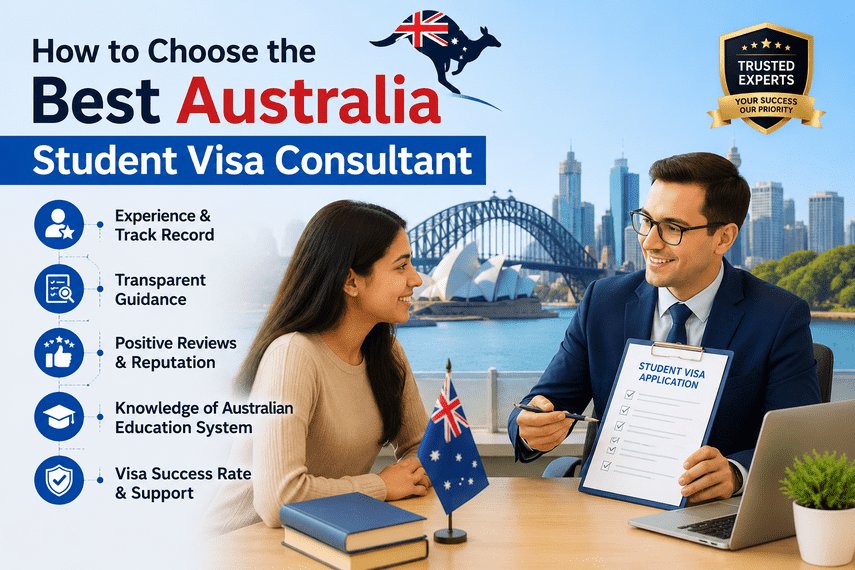
How do I choose an Australia student visa consultant in Ahmedabad?
Look for transparent fees in writing, no guarantees of visa approval, direct access to the university's own offer and CoE, and a refusal to use invented documents or templated statements. Ask them to explain your funds evidence in plain language.